3PL Quote
Normalizer Kit
Enter your order profile once. Enter up to five competing rate cards. Get true all-in cost per order for each vendor at your actual volume, a twelve-month projection with seasonality, and whether that ranking holds as your volume changes.
30-day money-back guarantee
Using this on client work? The $99 licence already covers that, and you can hand a client the output. The Agency licence at $299 covers everyone at your firm and lets you hand over the workbook itself.
Agency licence — $299 →.xlsx · 14 tabs · formulas only, no macros · version v1.0.9, updated 2026-08-18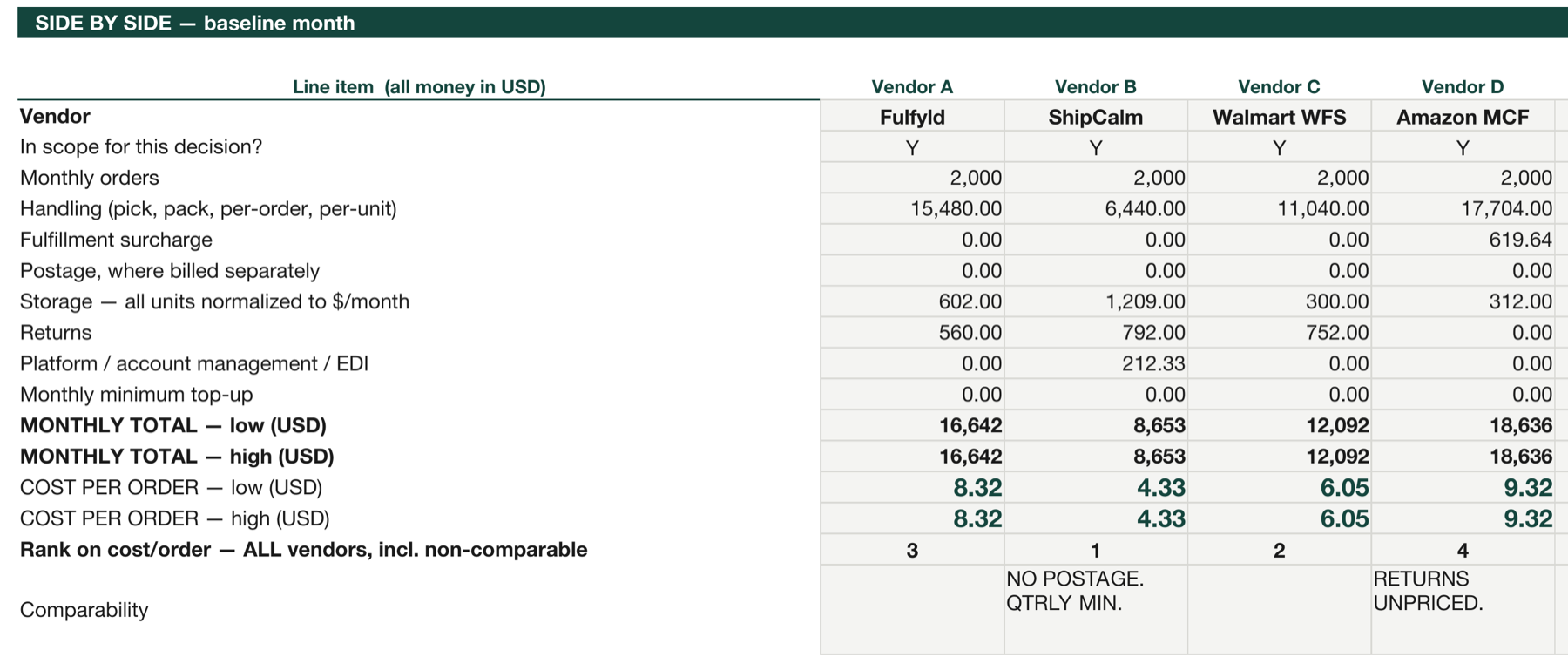
What it does
The reason quotes cannot be compared is structural, not arithmetic. Vendors slice identical work into different line items: per-order versus first-item-plus-additional picking, storage per bin versus per cubic foot versus per pallet, software billed weekly or buried in the pick fee, shipping marked up invisibly. The workbook rebuilds every quote against one order profile and reports a single comparable number, then shows you which line items are actually driving the difference.
What is inside
What you actually get
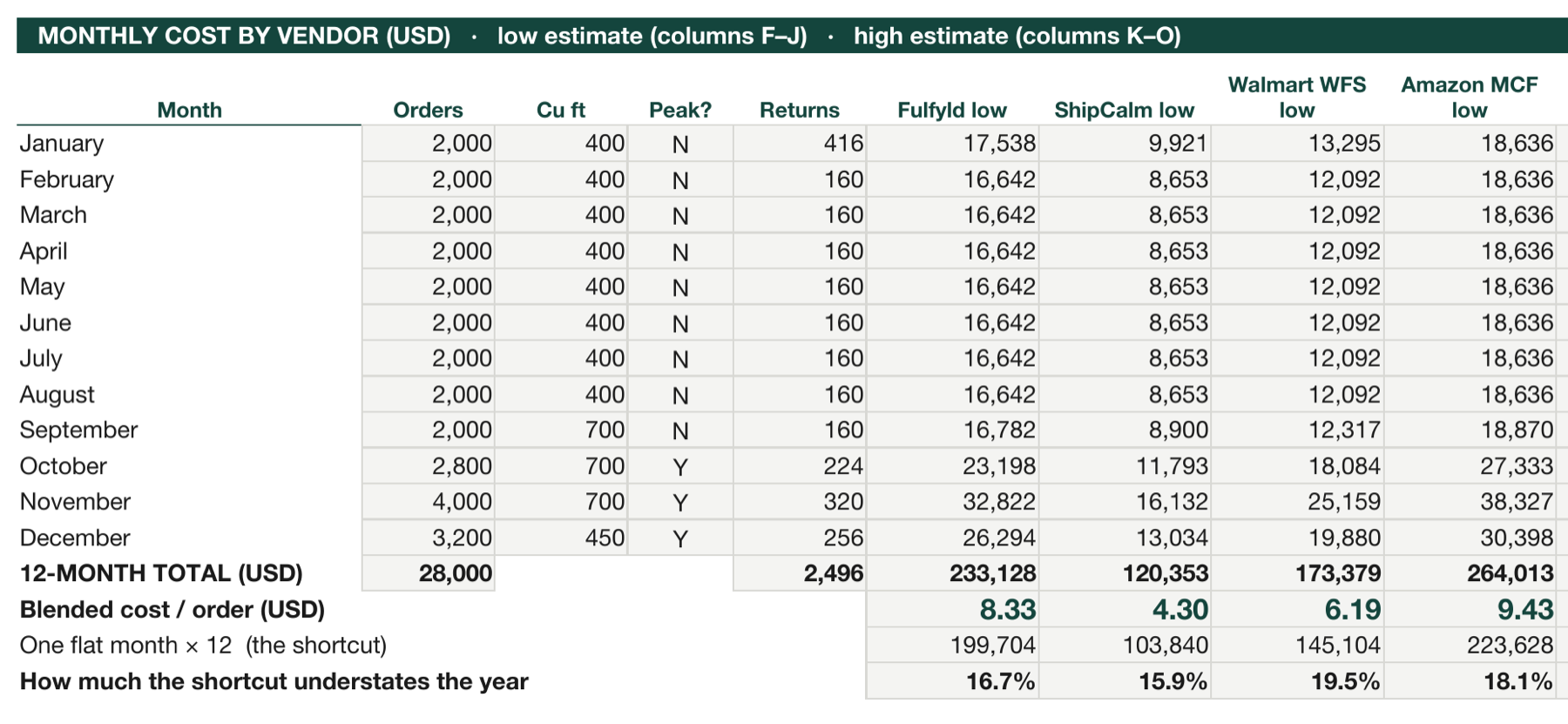
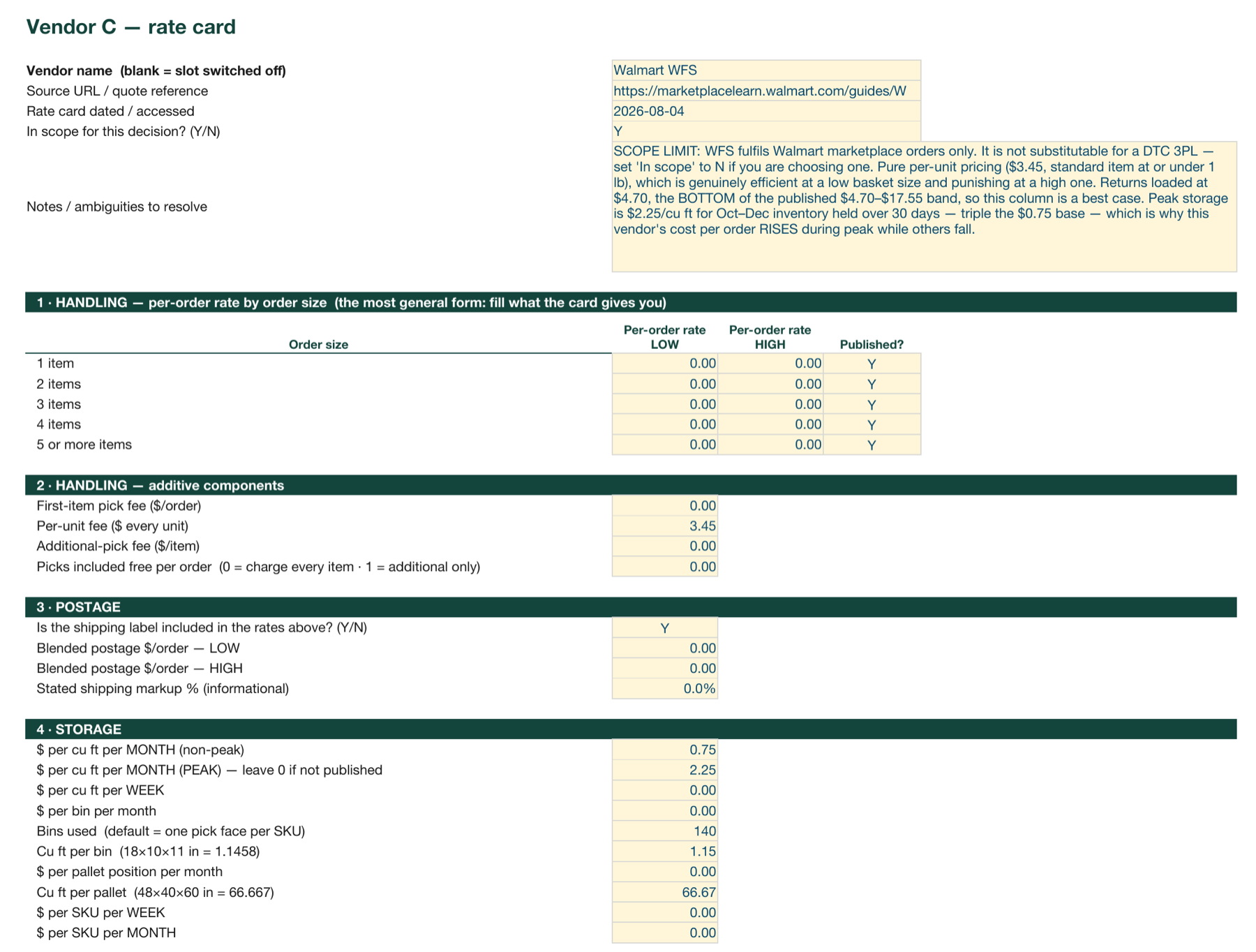
These are screenshots of the file itself, not mockups. The numbers in them are the four published rate cards our own worked example uses, so you can check every one against the guide before you spend anything.
Here is what it is worth. On that example, pricing a year by taking one month and multiplying by twelve gives $199,704 for the first vendor. The actual twelve months, with peak volume, peak storage and the January returns wave, come to $233,128. The shortcut is $33,424 light on one vendor, and it is light by a different amount on each of the others, which is how a shortcut quietly reorders a ranking. That is the mistake $99 is against.
Who it is for
Operators running 500 to 20,000 orders a month who are choosing a 3PL, renegotiating with their current one, or building the case to leave. If you have one quote and no comparison, the workbook will not manufacture leverage you do not have. If you have three, it will tell you which one is actually cheapest at your volume, which is rarely the one with the lowest headline pick fee.
Try the method first
The full normalization method is published free, with worked examples against real rate cards: How to compare 3PL quotes apples to apples. The Kit automates it. If you would rather build it yourself from the guide, that is a legitimate outcome and the guide is written to make it possible.
It handles marketplaces too, not only 3PLs. Walmart WFS and Amazon MCF price per unit by weight tier while a 3PL prices per order, and usually only one of the two includes the label — which is exactly the mismatch the workbook exists to remove. The worked example ships with Walmart WFS priced against three 3PLs on the same order profile, so if you are deciding whether to stay on WFS or move, that comparison is already built.
$99, once. Against a 3PL contract worth thousands a month.
One payment, yours to keep. Run it against every quote you get, this year and next.
Get the Kit — $99 →Would rather not do it at all? Send us the quotes and we will run this for you and write up the answer — the quote audit, $500 flat.
Excel .xlsx, 14 tabs, formulas only, so nothing here can run code
on your machine. Verified in Google Sheets — it imports with no warning and the formulas stay
live. Also opens in Apple Numbers and LibreOffice. Version v1.0.9, updated 2026-08-18.
30-day money-back guarantee, no questions — see the refund policy. Find an error in a rate or a formula and it gets published at corrections, and buyers get the corrected file: data@ratecardlab.com.
Not buying today?
The dataset behind the Kit is free and we keep re-checking it. Leave an address and you get an email when a vendor moves a published rate, a company is added, or the Kit itself is updated — nothing else, and nothing on a schedule. To come off, email data@ratecardlab.com and we delete the record.